阿里巴巴
Chinese-made infrared telescope with domestic detectors achieves astronomical imaging, reducing foreign reliance_我的网站

A |
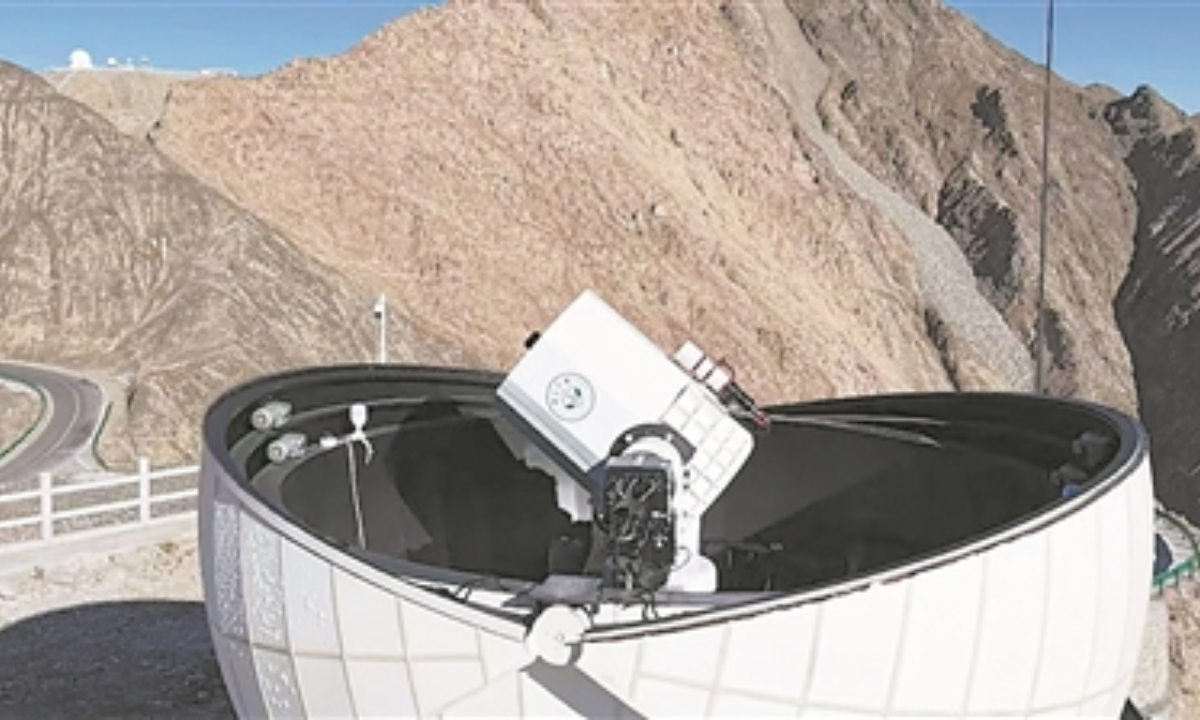
Chinese scientists on Wednesday released the first complete set of observational images captured by China's new-generation ground-based infrared telescope, filling a gap in the country's near-infrared astronomical observation capabilities and reducing reliance on foreign infrared detector technology, China News Service reported on Wednesday.
The 80-centimeter near-infrared telescope was installed at Saishiteng Mountain, Lenghu township, Northwest China's Qinghai Province in October 2024. Jointly developed by Sun Yat-sen University and several partner institutions, the telescope is China's first to achieve scientific imaging in the 1.2-micrometer J band and 2.2-micrometer K band using domestically developed scientific-grade InGaAs and HgCdTe detectors.
The telescope enables unattended remote operations, and can lock onto any target in the sky within 15 seconds. Its infrared capability allows it to see through interstellar dust, enabling it to observe cold and distant celestial objects that are difficult for optical telescopes to capture.
According to Ma Bin, a professor at the School of Physics and Astronomy, Sun Yat-sen University who led the research team that released the infrared telescope's observational images, all three of the telescope's core astronomical observation capabilities were fully validated during operation.
It rapidly responded to and tracked multiple gamma-ray bursts and supernova events, recording the evolution of their infrared afterglows following the explosions. It continuously monitored brown dwarfs, precisely capturing periodic variations in their atmospheric brightness. Using image-stacking technology, it also observed active galaxies billions of light-years away.
Since its deployment in Lenghu, the system has supported infrared observations for more than 10 Chinese research institutions, accumulating valuable experience for the construction of future large-scale infrared telescopes.
Lenghu township, where the world-class astronomical observation base takes shape, is hailed as "the most Mars-like place on the Earth." The astronomical observation base was said to be an astronomical observation site comparable to the top ones in the world by a Nature article published on August 18, 2021, according to the Chinese Academy of Sciences.
Once prospered in 1950s due to its rich petroleum resources, Lenghu is now becoming a premier astronomical observation site and Mars-themed tourist destination, according to Xinhua News Agency.
Global Times
。 AI摘要 8月17日,福建省“电影+”消费推进会在福州召开。
B | 会议部署落实“2026电影经济促进年”工作,提出通过优质内容、惠民补贴、票根经济及终端建设等举措,提振电影消费市场。 东南网8月18日讯(福建日报记者 林清智 郭斌) 8月17日,福建省“电影+”消费推进会在福州召开。

C | 会议贯彻落实国家电影局关于“2026电影经济促进年”及“电影+”消费综合试点工作部署,交流推广试点城市经验做法,研究部署相关思路举措。 会议指出,电影是服务消费的重要组成部分,也是拉动关联消费的强劲引擎。全省各地要深入贯彻落实党中央决策部署及省委工作要求,切实把电影促消费工作抓紧抓实抓出成效。要以优质内容供给为根本,加大对优秀影片的创作扶持力度,高度重视排片和宣发工作,以好作品夯实电影消费“基本盘”;以惠民补贴为杠杆,用好电影促消费专项资金,主动对接金融机构和票务平台,降低群众观影“门槛价”;以票根经济为纽带,推动影院与商圈、酒店、景区等消费场景建立票根互认机制,拓宽电影消费“生态圈”;以终端建设为支撑,推动电影院向综合性文化体验空间转型,做大做强县域电影市场,打通电影消费“最后一公里”。 会上,福州市委宣传部就“电影+”消费综合试点工作进展作专题汇报,厦门、漳州、泉州市委宣传部,2026年票房表现优秀的晋江、福清、南安、仙游、福鼎等5个县(市)党委宣传部以及院线代表作交流发言。相关省直单位、省内金融机构代表参加了会议。
Current article:http://nmd.tichannangenzhuchuapin.cfd/lgtlt/9lfse.html
Published on:13:16:21


